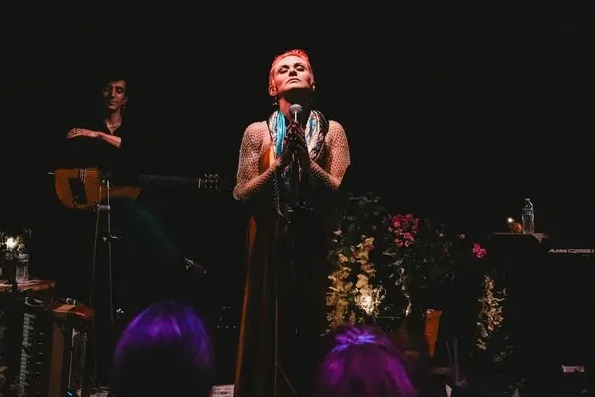
Tromba Vetusta has built its reputation on contradiction: a duo that is equal parts dream and chaos, delicate and loud, theater and music, often in the same breath. Alejandra Matus and Dabit Azofeifa, the Costa Rican pair behind the act, have spent years refining a style that resists easy description.
Matus is the voice. Her range and control anchor every show the duo builds, and she treats singing less as a skill than as a kind of open-ended exploration, one she says she’s still mapping out after years on stage.
Azofeifa works the physical side, mixing clowning, rhythm, and a sense of comic timing that softens whatever the music is doing underneath. Together they’ve turned that combination into a body of work that includes Circoncierto a show that found an audience in Puerto Vallarta and hasn’t let go since.
This season, the duo brings three productions to local stages, each built around a different mood.
Circoncierto
Their best-known piece runs every Saturday at 5 p.m. at The Palm Cabaret & Bar. It’s part circus, part clowning, part live music, and part storytelling, held together by vintage costumes and an intimacy that’s unusual for a show with this much physical comedy packed into it.
One review described it as a piece that will “leave you uplifted, haunted and smiling long after the final bow,” which is about as accurate a summary as you’ll find for something that swings this hard between silliness and melancholy.
As Matus put it, the show is “built by two performers doing everything at once, musical eccentricity and physical comedy from head to toe. It’s pure clowning, and it’s meant to bubble over with joy.”
ODA
The newest addition premieres December 10 at 5 p.m. and then settles into a weekly slot at Coco Cabaret.
Where Circoncierto is loose and comic, ODA is a different animal entirely. Azofeifa calls it “a surrealist production with eleven performers blending acrobatics, contemporary dance, object work, circus, and theater, all built around live music.”
It’s a larger show, with original music, physical performance, and costume design meant to carry as much of the storytelling as the script does, built around transformation rather than narration. “It asks a lot more of the audience,” Azofeifa said, “but it pays off.”
He’s quick to add that neither show is really meant for one kind of crowd over another: both pieces are originals, shaped by body language first. “They’re both for everyone. That part hasn’t changed.”
Fado
Returning to Nacho Daddy for a second season, this one happens just once a month, the first Sunday, at 5 p.m.
Instead of the circus and physical theater of the other two shows, this is a seated, candlelit concert built around Portugal’s fado tradition, with Matus singing material from Madredeus, Mariza, and Amália Rodrigues alongside a small ensemble on violin, guitar, and accordion.
Matus describes it as “a different kind of night completely, a concert experience that pays tribute to the heart of Portuguese folk music,” one where “once a month, people get an evening that moves them in a different way, while the live music creates something that only happens that one night.” It’s the quietest thing the duo does, and that’s the point.
What the City Gave Them
Ask Troma Vetusta what Puerto Vallarta has meant to the group’s work, and they don’t talk about venues or crowds so much as about what the city let them become.
“Puerto Vallarta has been a gateway for us,” they said, “a place full of surprises and more generosity than we expected. Every venue gives us a different chance to raise our voices.”
What interests them isn’t the idea of a place shaping an artist, but the reverse: “It’s not really about letting a place shape you. It’s about how you shape things yourself once you’re there. We’ve broken a few molds along the way, and we’re fine with that, because making something new right now feels like its own kind of statement.”
They treat the hard parts of that process the same way. “We try to treat obstacles as material to work with, not as a verdict on what we’re capable of. If anything, Puerto Vallarta has made us more stubborn about staying students of this, as people and as artists.”
A clowning circus act, an eleven-performer surrealist production, and a once-a-month fado concert are, on paper, three very different nights out, and that’s exactly how Matus and Azofeifa want it.
Circoncierto runs Saturdays at The Palm Cabaret & Bar. ODA opens December 10 and continues weekly at Coco Cabaret. Fado returns the first Sunday of each month at Nacho Daddy.