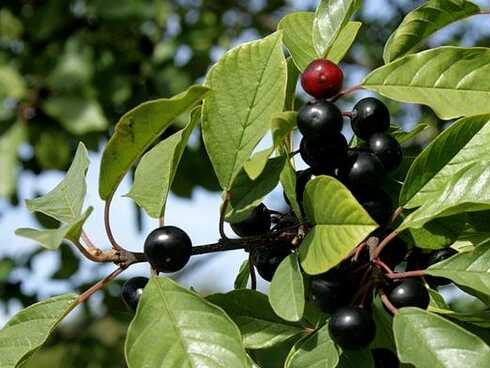
(Frangula alnus) Family: Rhamnaceae
Also known as: Arrow Wood, Berry-bearing Alder, Black Alder, Black Dogwood, Breaking Buckthorn, Glossy Buckthorn, and Glossy False Buckthorn
Origin: North Africa, Lower Europe and parts of western China
Right from the proverbial “Git go,” don't confuse Alder Buckthorn with European Buckthorn, Sea Buckthorn or the exotic, large-leaf-clad, dancer of the 1940’s Macau, Bernadette - ‘Boom Boom’ - Buckthorn! Okay. Don’t dwell on that mental image. Let’s continue with business!
Early on, in my research on this tree, my thoughts were of the catch phrase exclaimed by Jimmy Walker’s – a bit over the top character - “J.J.” on the late 1970s TV series, “Good Times” - “Dy-no-mite!”
“Why,” you asked? Well, the debarked, dried (to approximately 10% moisture content) wood, smolder-burned to a carbon condition, and then milled (reducing the charcoal to fine particles over twenty-four to forty-eight hours) provides one of the key ingredients in gun powder production! Once that rather interesting fact has soaked in, ponder also that the Alder Buckhorn’s berries contain an integral component used in the production of various natural pigments and dyes.
(And, when you started reading, you thought I was only going to share plant medicinal aspects!)
However, as serves the prime purpose and direction of this column – the ethnopharmaceutical aspects of semi-tropical and tropical plant life, read on.
Since the Middle Ages - inasmuch as the bark contains anthraquinones, which act on the walls of the colon, stimulating a bowel movement approximately eight to twelve hours after ingestion - Frangula alnus has long been used as a gentle laxative and, yet today, is still taken for chronic atonic constipation. (For those like me, with but a limited vocabulary, “atonic” is not some sort of nuclear bomb, but rather means “without stress.”)
But, should you wish to impress someone who complains of chronic constipation, casually, and in an off-hand manner, quietly say, “Ya’ know, as I recall, anthraquinone stimulates the colon by increasing fluid secretion into the small and large intestine and, accordingly, directly increases intestinal motility by activation of the myenteric plexus and should, thusly, render that condition soon resolved for you!”
But – lightness aside and rather importantly – take note that some sources cite that its glycosides can cause cramps, diarrhea, drooling, gas, nausea, upset stomach, and vomiting – a condition I vividly recall having achieved in my early college days from foolishly imbibing too much of a friend’s concoction of “Purple Passion after “Finals Week!”
For centuries, it has been reported and recorded to have various medicinal applications as a result of certain of its parts containing anti-oxidants, beta-carotene, vitamin A, C, and E with their inherent ability to battle inflammation. In fact, going from internal to external uses, a concentrated puree from the berries has long been used to relieve sunburn, and some say it could be suitable for various skin conditions.
Additionally, as a good source of omega-6 fatty acids, Alder Buckhorn may help reduce acne and eczema. Its oily compounds have been promoted as good for all hair types, bringing strength and shine to hair shafts and restoring their elasticity. Its containing of Linoleic acid is said to help regulate scalp oil and boost blood circulation in the promotion of hair growth.
Whereas, its bark was, traditionally, boiled in ale for jaundice and taken in a tonic form for intestinal pain relief and hemorrhoid difficulties. (But, while providing such - as well as relief from digestive disorders – keep in mind that its potency demands substantial respect in that if taken in high doses, it can be toxic.)
Today, it is also employed for the treatment of abdominal bloating, cirrhosis, gall bladder complaints, hepatitis, jaundice and liver difficulties.
The bark can be used to treat gum diseases and scalp infestations or as a lotion for minor skin irritations.
The folks on WedMD give it sort of a left-handed, medicinal usage endorsement, stating “Alder buckthorn is ‘likely safe’ for most adults when taken by mouth for less than 8-10 days.” (Is that similar to saying “You’ve 1:6 odds all will go well in Russian Roulette?”)
But back to Bernadette. She did more for young men’s leaf structure study than ten botanical classes!